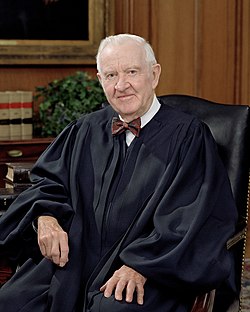
Justice John Paul Stevens made some pointed comments on his potential retirement in interviews this weekend, sparking a second wave of rumors regarding his departure from the Court. Stevens initially drew media scrutiny last October after it came to light that he had hired only a single clerk for the 2010-2011 term--sitting justices generally employ four clerks, while retired justices are only permitted one.
If he is planning to retire, Stevens will have to make a public announcement relatively soon in order to allow sufficient time for the nomination and confirmation process of a new justice before the Court enters a new term in October.
Although Stevens has suffered few health problems during his tenure--he is the second-longest serving justice in history and will turn 90 on April 20th--he notably stumbled in his oral statement on Citizens v. FEC last January, marking the first time the potential decline of his intellectual facilities came under discussion. Stevens himself acknowledged the misstep in an interview with The New York Times, calling his loss of control "a novel experience." Considering the profound importance of a justice's mental capacity in relation to his ability to serve reliably in his post, one might argue that Stevens is justified in stepping down during this upcoming recess.
Democratic party leaders, however, are urging Stevens to postpone his retirement in light of the threat of a GOP filibuster during any confirmation hearings this year. Sen. Arlen Specter (D-Penn.) articulated his fear that the Senate would be "bogged down" by a filibuster in an interview on Fox News on Sunday.
While one might argue that a justice would be foolish to ignore the contemporary politics, stricter constructionists might maintain that a sitting justice's supposed neutrality would prevent him from taking such factors into consideration when deciding to retire. While the Founding Fathers did not anticipate political parties, Alexander wrote in Federalist #78 that a justice must never form alliances with another branch of government, which makes a partial case against Stevens' delaying his retirement for "political" reasons.
Should justices take the political climate into consideration before deciding to retire? Sound off in the comments.

Retirement shouldn't be dictated by the politics of the moment -- especially if one's faculties are fading. I understand that there are certain political "moments" where retirement might be disastrous for one party or the other. We may well be in one of those moments. But I'd prefer to stick to the principles as constructed by the founders. And so I'm with A-Ham on this one.
ReplyDeleteI just finished reading The Nine by Jeffrey Toobin -- a great book about the Supreme Court's history and current direction. The book made clear to me that all too often the selection or retirement of justices is a highly politically-charged act. It shouldn't be. I agree with Gocsik; Stevens should feel free to retire. It rests with President Obama and the legislature to consider the founding fathers' intent when they select a new justice. They're the ones that should feel the pressure -- not Justice Stevens.
ReplyDelete